

Welcome to the website of the Crawford County Office of District Attorney. I hope that the information provided is interesting and useful to you.
The Crawford County Office of District Attorney has the authority to investigate and prosecute crimes that occur in our county. In each case that we prosecute, my office represents the citizens of the Commonwealth of Pennsylvania.
It is my goal to protect the rights of crime victims and their families. We do this by vigorously prosecuting, in a fair and ethical manner, those who break our laws. My office cannot be successful without the cooperation of victims and witnesses. Please join me and our dedicated state and local police officers in our fight to keep Crawford County a safe place to live and work.
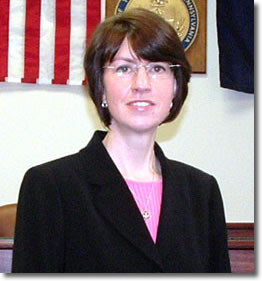
–District Attorney Paula Digiacomo
Office Information
The Crawford County District Attorney’s Office is located on the Lower Level of the Crawford County Judicial Center at 359 E. Center St. in Meadville, Pennsylvania. The office is open Monday through Friday from 8:30 a.m. to 4:30 p.m
The office is closed on the following county holidays:
News & Information
Be aware of the dangers of “sexting”
Sexting: the exchange of sexually explicit photos through text messaging.
You think sexting is a joke? Think again. Sexting can be a crime and can potentially be dangerous. Let’s face it, most teenagers we know have a cell phone and use it constantly. Many cell phones are equipped with digital camera and video features. In a disturbing trend, kids are using their cell phones to take sexually explicit photos of themselves and then sending the photos to other kids via their cell
phones.
Most students, parents and teachers do not realize that when sexually explicit photos of kids under 18 are sent from cell phone to cell phone, serious crimes are being committed. In Pennsylvania, the photographing of a child under 18 engaged in a prohibited sexual act is against the law, as is the dissemination of such a photograph. Photos that depict a lewd exhibition of the genitals or photos depicting nudity in a sexual manner are considered prohibited sexual acts.
Here’s an example: 14-year-old Sally thinks it would be cool to send some nude photos of herself to her 15-year-old boyfriend Jim-for his eyes only. Jim and Sally break up. Jim then sends Sally’s nude photos to all his friends with cell phones. Jim’s friends send them to their friends in other schools. Soon Sally’s nude photos are all over school, all-over town and have even made their way onto the internet. Sally and her parents are humiliated. A child sexual predator has even
seen Sally’s photos on the internet and has taken an interest in her.
Everyone who has possessed Sally’s nude photos on their cell phone has committed a felony offense. Every person who has sent Sally’s nude photos to someone else has committed a felony offense. These crimes can lead to arrest, prosecution, court appearances, adjudication, conviction, fines and costs, probation, placement in a juvenile facility and even jail. A juvenile record can negatively affect
a student’s ability to attend college, receive financial aid or get a job. Sexting is no joke.
Tips for parents:
- Talk to your kids about the legal consequences and potential dangers associated with sexting
- Set limits and rules for the use of your child’s cell phone and/or computer
- Periodically view the contents of your child’s cell phone and/or computer
- Be engaged in your child’s life
Tips for students
- Don’t take photos of yourself that you wouldn’t want your parents or grandparents to see
- Don’t let anyone talk you into sending a nude or explicit photo of yourself
- Keep in mind that once a photo is sent to a cell phone or computer, you cannot control who will see it or how many people will see it
- If someone sends you a photo containing sexually explicit or nude images, erase it immediately
District Attorney Francis J. Schultz
*Crawford County Juvenile Probation Officer Sam Pendolino contributed to this article.
DEBUNKING THE CLAIM THAT PRISONS ARE FILLED WITH “PETTY DRUG USERS”
A guest editorial appeared in the Wednesday, March 28, 2008, edition of the Meadville Tribune, authored by the Pocono Record, entitled “Why Are So Many People in Jail in Pennsylvania?”
This editorial was absurd. After reading the editorial, John Q. Public is erroneously led to believe that our state prisons are filled with-as the Pocono Record claims- “occasional marijuana users” and “first-time petty drug users.” The Pocono Record does not offer one example of an individual who was sent to state prison because he or she was simply a “petty drug user.” They can‟t do so because in Pennsylvania, it is impossible for a person who has only been convicted of the simple possession of marijuana or the possession of a controlled substance to be sentenced to a
state correctional institution. These crimes are ungraded misdemeanor offenses that carry a maximum of thirty days in jail and a maximum of one year in jail respectively.
Pursuant to the sentencing laws of Pennsylvania, only sentences handed down by a judge that have a maximum of at least two years can be served in a state prison. Therefore, individuals convicted of only “petty drug offenses” cannot be sentenced to a state correctional institution.
The Pocono Record claims that Pennsylvania must re-evaluate its mandatory minimum sentencing laws because their use has filled our prisons with people who do not deserve to be there. In drug cases, mandatory minimum sentences only apply to individuals who have been convicted of manufacturing, delivering or selling a certain quantity of a controlled substance. These people are
not “occasional marijuana users.” These people are criminals who terrorize communities. They ruin lives and they are accomplices to the perpetration of the vast array of crimes drug users commit to
support their habits. A drug dealer does not have to wield a machine gun to be a menace to society.
In Pennsylvania, there are no mandatory minimum jail sentences for simple possession charges. I have been a prosecutor for 11 years, and I assure you that it is extremely rare for a person who is only convicted of a drug possession charge to be sent to jail. In fact, in Crawford County, offenders who have no prior criminal record who are charged with the possession of a small amount of marijuana or some other controlled substance, are either given a probationary sentence or are admitted into the Accelerated Rehabilitative Disposition Program. Defendants convicted of possession charges only get sent to county jail when they have amassed a lengthy criminal record by committing crime after crime.
Just because two thirds of the 10,000 prisoners in the state system may be classified as “nonviolent” certainly does not mean they do not deserve to be behind bars. Ask a person who has come home to a ransacked and burglarized home if the perpetrator should not spend time in jail. What about people who repeatedly drive drunk or who steal large sums of money from their employers? What about criminals who scam the elderly out of their life savings? These are all nonviolent offenses.
Is the Pocono Record telling me these criminals don’t deserve jail time because they did not do physical harm and it costs money to incarcerate them? Of course they deserve it, and society expects it. People who end up serving time in state prison have earned it. My office has convicted many “nonviolent” offenders who deserve every day of the state prison sentence they received.
This assertion that our prison system is overcrowded with individuals, whose only crime is the occasional use of marijuana or some other drug, is a myth that is perpetuated by certain members of the media and drug advocacy groups who seek to abolish America’s drug laws.
Francis J. Schultz
District Attorney